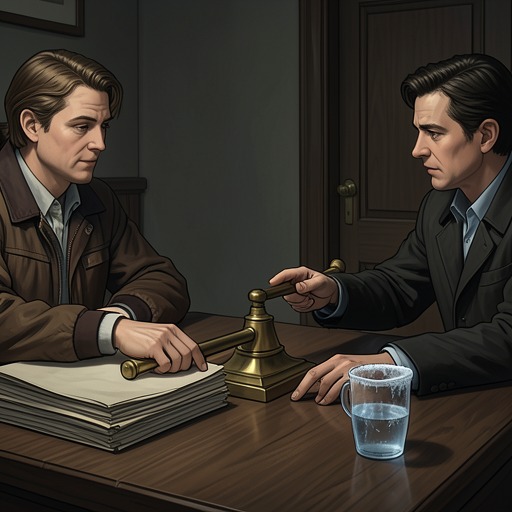
Aza and Daisy keep and deposit the cash
Turtles All the Way DownAza Holmes and Daisy Ramirez keep and deposit the $100,000 Davis Pickett gives them in exchange for stopping their investigation into Russell Pickett’s disappearance. The action converts a fraught bargain into an equal, formalized windfall: each takes $50,000, and both open bank accounts. Their decision is practical and affirmative, but not uncomplicated. Aza worries that the money is tainted by privilege or takes advantage of Davis Pickett; Daisy insists that refusing it would not make them nobler. The deposit settles what they will do with the cash, not the questions surrounding the Pickett family or the information they have uncovered.
The payment and the decision
After putting away her father’s old phone and its charger, Aza Holmes is in Harold when Daisy Ramirez approaches Applebee’s. Daisy asks for a ride home, and Aza tells her there is a bag beneath her seat. Daisy reaches down, opens it, and is overcome: she whispers in disbelief, tears forming in a reaction Aza has never seen from her before. The money is not abstract or promised for later; the cash is already there with them.
Aza explains that Davis Pickett considered the payment worth making because he would rather give them the reward than have them continue snooping. When Daisy asks whether the money is real, Aza says it appears to be, and mentions that Davis Pickett’s lawyer is expected to call the next day. Daisy recognizes the sum as $100,000. Aza proposes that they keep it and confirms that the division is $50,000 apiece. Daisy’s immediate answer is yes.
The exchange makes the reward’s terms emotionally tangible. What had been connected to an investigation and a request for silence becomes a bag Daisy can open and money the two friends can choose to retain. Daisy’s tears register the shock of the amount; her quick decision contrasts with Aza’s more hesitant response. Neither the payment nor the decision erases how the money came to them.
Disagreement over what the money means
Aza remains troubled by the possibility that the money is dirty or that accepting it means exploiting Davis Pickett. She also objects that they received it because they knew someone. Daisy answers by comparing their position with Davis Pickett’s: he, too, acquired his wealth through connection, specifically through his father. In her view, accepting the payment is neither illegal nor unethical, and turning it down would not acquire moral value simply by being a refusal.
Their disagreement is less about the amount than about what acceptance says. For Aza, the reward raises the problem of whether an advantage gained through personal access can be used without guilt. Daisy counters that such access is already woven into the distribution of wealth, including the wealth surrounding the Pickett family. Her argument does not change the source of the payment; it changes the standard by which they judge themselves for taking it. The decision to keep the money is therefore also a disagreement, briefly negotiated between friends, over whether refusing a benefit would actually correct the inequality that produced it.
From cash to bank accounts
A caller who knows that Aza Holmes has received a gift from Davis Pickett raises a practical obstacle: a teenager arriving at a bank with a large quantity of hundred-dollar bills may arouse suspicion. The caller has spoken with a banker at Second Indianapolis and arranged an appointment for Monday at 3:15 p.m. at the branch on Eighty-Sixth Street and College Avenue. The conversation removes a logistical barrier without changing the fact that Aza and Daisy must decide what to do with the money themselves.
At the bank, Daisy introduces herself to a teller. The two are taken to a glassed-off private office, where a woman in a black suit runs the cash through a counting machine. They fill out forms and leave with newly opened accounts. Their debit cards are due to arrive in seven to ten days; until then, they receive five temporary checks. The banker advises them to avoid major purchases for at least six months while learning to live with the windfall, then discusses possible places for the money, including college savings accounts, mutual funds, bonds, and stocks. The reward has moved from an exposed bag into the ordinary structures of financial life, though its suddenness is still apparent in the banker’s caution and the temporary checks.
For Aza, the account-opening scene is also interrupted by a private crisis. As the banker counts the bills and explains their options, Aza is absorbed in fear about an infected fingertip. She believes that she opened a callus herself and failed to change its Band-Aid for more than a day; the sensation of heat and soreness seems to confirm her escalating fear. The contrast is sharp: the money is being measured and safely deposited outside her, while her attention is pulled into an anxious spiral about her body. Aza is physically present for the transaction but struggles to attend to it. The deposit records a consequential choice even as her thoughts make the moment difficult to inhabit.
The Pickett estate behind the bargain
The payment sits within a legal uncertainty that gives the Pickett family’s silence unusual weight. Russell Pickett had publicly announced that he would leave his estate to Tua, his pet tuatara, through a foundation intended to study and care for the animal; after Tua’s death, the fortune would pass to a trust benefiting tuatara everywhere. Aza and Daisy’s reward is thus connected not only to the missing billionaire but to the possible destination of his wealth.
The legal arrangement is not the same as a settled account of what has happened to Russell Pickett. A caller explains that Indiana law treats a missing person as alive until evidence of biological death emerges or seven years pass after the last evidence of life. Davis Pickett has been declared an emancipated minor and is the legal guardian of his younger brother, Noah Pickett. The caller also distinguishes formal administration from personal care: financial affairs are administered by one person, household affairs by a house manager, and Davis Pickett is the guardian. Aza’s concern is not simply whether the legal roles have been assigned, but who will actually look after the brothers. The distinction shows how the law can allocate responsibility while leaving an emotional question unanswered.
That estate context returns when Aza and Daisy later consider reporting information about Russell Pickett’s possible whereabouts. Aza tells Daisy that she will tell Davis Pickett, but not the police: if Russell Pickett is dead, she says, Davis Pickett and Noah Pickett could lose their home to a tuatara. This later decision recalls the same tension present when they accepted the payment. Their agreement to stop investigating does not, by itself, explain every subsequent choice, but the legal consequences of Russell Pickett’s disappearance remain bound to the animal-beneficiary clause and the brothers’ security.
Aftermath and significance
A month later, a television report announces that a body found in an offshoot of the Pogue’s Run tunnel is believed to be Russell Davis Pickett, Sr. The report says authorities have not positively identified the body; sources believe he died of exposure within a few days of disappearing, and say police found him after an anonymous tip. Aza immediately texts Davis Pickett with condolences, then clarifies that neither she nor Daisy Ramirez tipped off the police and that they had not told anyone. The report does not identify the tipster, and Aza’s message does not resolve the circumstances of the discovery. It does, however, make their insistence on keeping the investigation private newly consequential.
The deposit is therefore both a completed transaction and part of an unresolved moral arrangement. Aza and Daisy take equal shares of the reward, place the cash in accounts, and accept the practical benefits it offers. Yet the money remains linked to their promise to stop snooping, to Aza’s later choice not to involve the police, and to a will that could redirect the Pickett home and fortune. The scene’s movement from an open bag to counted bills and bank accounts gives the decision a firm material shape; the later report shows that no financial procedure can make the underlying loss, silence, or uncertainty equally settled.